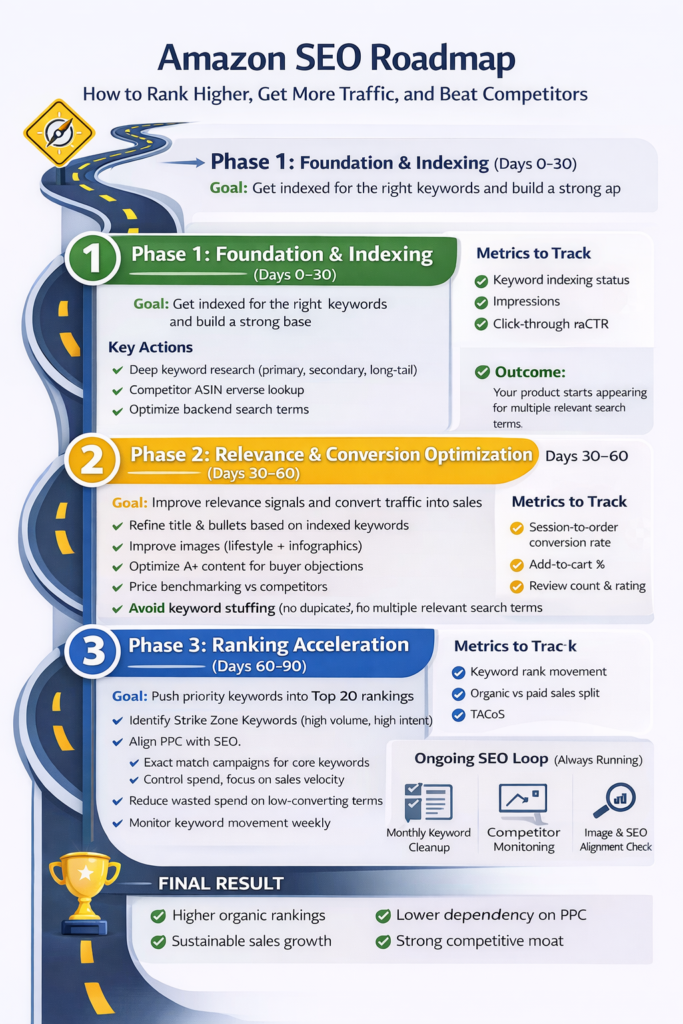

Are your Amazon listings stuck on page 3, 4, or 5 while competitors dominate page 1?
You’re not alone.
Most Amazon sellers struggle with SEO because Amazon never clearly explains how ranking works. Many believe running ads or changing prices will magically improve rankings. Others think SEO is a one-time activity.
The truth is simple:
Amazon SEO is a structured, data-driven process.
If you follow the process consistently, rankings improve. If you don’t, even heavy Amazon PPC spend will fail.
This guide explains Amazon SEO in clear, actionable steps, with practical examples so you know what to do, why it works, and how to apply it.
Understanding Amazon SEO (How Amazon Actually Thinks)
Amazon’s only goal is to sell more products.
It does not rank products based on:
- Brand size
- Seller reputation
- Time on the platform
Amazon ranks products based on purchase probability.
In simple terms, Amazon asks:
“If I show this product for this keyword, will it get clicked and purchased?”
Your ranking depends on:
- Keyword relevance
- Click-through rate (CTR)
- Conversion rate (CVR)
- Sales velocity
- Listing completeness
If your product gets impressions but no clicks or sales, Amazon pushes it down—no matter how much PPC you run.
Amazon Keyword Indexing vs. Ranking (Most Misunderstood Concept)
What Is Keyword Indexing?
Indexing means Amazon recognizes your product for a keyword.
For example:
If someone searches “protein powder for men” and your product appears anywhere in the top 300 results, it is indexed.
Indexing does not mean visibility.
Most sales happen on page 1 and early page 2.
What Is Keyword Ranking?
Ranking is the exact position of your product for a keyword.
- Positions 1–10 = maximum sales
- Positions 11–20 = good sales
- Positions 21–50 = strike zone (high growth opportunity)
- Positions 50+ = almost invisible
Common Indexing & Ranking Problems
- Product indexed for many keywords but not selling
- Ranking stuck between positions 60–120
- No improvement despite ads
Realistic Amazon SEO Growth Timeline
SEO is gradual. A healthy roadmap looks like this:
- Day 30: Index ~1,000 relevant keywords
- Day 60: Expand to ~1,200 keywords
- Day 90: Rank at least 50 keywords in positions 20–50
Without ranking, indexing alone is useless.
Search Terms & Backend Optimization (Hidden SEO Power)
Backend search terms help Amazon understand relevance, not customers.
Common Mistakes Sellers Make
- Leaving backend fields partially empty
- Stuffing random keywords
- Using punctuation and wasting character space
How to Optimize Search Terms Properly
- Use competitor ASIN research
- Include synonyms, variations, and use cases
- Avoid repeating title or bullet keywords
- Use spaces between every word
Backend optimization helps you index faster and wider, especially for long-tail keywords.
Listing Optimization: The Real Foundation of Amazon SEO
Before PPC, before discounts—listing quality comes first.
Common Listing Issues
- Titles focused only on brand name
- Bullet points written like brochures
- No keyword prioritization
- Poor images that don’t explain the product
How to Fix Listing Optimization
- Use high-volume keywords early in the title
- Write bullets focused on problems solved
- Maintain a 2:1 ratio of organic to PPC keywords
- Ensure images explain usage, benefits, and comparisons
SEO brings traffic, but listing quality converts traffic.
A+ Content: SEO + Conversion Booster (When Done Right)
Many sellers think A+ Content is only visual. That’s wrong.
Amazon reads A+ Content if it contains crawlable text and alt text.
Common A+ Content Mistakes
- Image-only modules
- No keyword-rich text
- No comparison tables
- No internal cross-selling
How to Optimize A+ Content for SEO
- Add keyword-rich text blocks (natural, not stuffed)
- Use alt text (up to 100 characters per image)
- Add comparison grids with your own products
- Build Brand Story modules to improve trust
Well-optimized A+ Content improves:
- Indexing
- Conversion rate
- Time spent on listing
Search Term Formatting Rules (Very Important)
Wrong formatting can reduce indexing—or even cause suppression.
Common Formatting Errors
- “proteinpowderformen” (no spaces)
- Using commas or pipes
- Adding claims like “best” or “number one”
Correct Backend Formatting
- Always use spaces
- No punctuation
- No repetition
- Follow Amazon policy strictly
This alone fixes indexing for many stuck listings.
Why Rankings Don’t Improve Even After Optimization
If rankings are not improving, one of these is usually the reason:
- Weak keyword placement
- Low CTR due to bad images
- Low conversion due to poor reviews or pricing
- No PPC support for strike zone keywords
Fixing Ranking Issues
- Push keywords ranked 20–50 using PPC
- Improve main image for higher CTR
- Add more clarity in bullets and A+ Content
- Support SEO changes with ads
Bullet Points, Descriptions & Backend: Best Practices
Bullet Points
- 200–300 characters each
- Start with a bold benefit
- Explain “why it matters”
Product Description
- Minimum 500 characters
- Explain use cases, storage, FAQs
- Avoid prohibited claims
Backend Search Terms
- Use relevant, unique keywords
- Avoid brand names and repetition
How Amazon PPC Supports SEO (Not Opposite)
PPC sends sales and relevance signals to Amazon.
Common Seller Mistakes
- Turning off PPC too early
- Running ads without SEO changes
- Expecting PPC to fix a bad listing
Correct PPC + SEO Approach
- Use PPC to push ranking improvements
- Support keywords already converting
- Reduce bids only after ranking stabilizes
Fixing Weak Listings That Don’t Convert
Common Causes
- No trust elements
- No reviews or poor ratings
- Missing alt text and crawlable text
How to Fix
- Improve images and A+ Content
- Add 500+ words of crawlable content
- Use PPC for strike zone keywords
- Leverage Reviews & Q&A for keyword ideas
Amazon SEO Checklist (Expanded)
Every optimized listing should have:
- High-volume and relevant keywords
- Fully used backend search terms
- Correct category mapping
- Keyword-focused title structure
- Keywords from customer language
- 500+ words of crawlable A+ text
- Alt text for every image
- No keyword duplication
- PPC supporting rankings
- Focus on strike zone keywords
Search Query Reports: Your SEO Goldmine
Search Query Reports show:
- Actual customer search terms
- Conversion rates
- Market share
Use them to:
- Remove waste keywords
- Scale winning keywords
- Align PPC and SEO decisions
Continuous Keyword Growth (Monthly Process)
SEO is ongoing.
Every month:
- Review new keywords
- Update backend and A+ text
- Adjust PPC targeting
- Track ranking movement
External Traffic & Link Building (Highly Underrated)
Amazon values branded searches.
Ways to Drive External Traffic
- Influencer content
- Blog posts
- Social media promotions
- Guest articles
External traffic increases trust and ranking stability.
PPC as an Organic Growth Accelerator
PPC today = organic growth tomorrow.
Strong PPC performance improves:
- Sales velocity
- Keyword confidence
- Organic ranking over time
PPC & SEO Synergy (The Winning Formula)
- Use PPC to validate keywords
- Push SEO rankings using ads
- Reduce PPC only after organic stability
SEO without PPC is slow.
PPC without SEO is expensive.
Final Thoughts
Amazon SEO is not about hacks.
It’s about consistency, data, and patience.
If you follow this structured approach, your listings will:
- Rank higher
- Convert better
- Reduce TACoS
- Scale profitably