

Launching a new product on a quick commerce platform comes with a unique challenge: there is very little historical data to work with.
Advertisers may not yet know which keywords drive conversions, which category pages generate sales, which cities perform better or what level of visibility the product requires.
Blinkit has introduced New Launch Boost, an auto-targeted advertising campaign designed specifically for this initial launch period.
Instead of requiring brands to manually select keywords and continuously optimise placements, New Launch Boost automates much of the process while providing reserved visibility and campaign-level insights.
Here is how the new campaign works.
What Is Blinkit New Launch Boost?
New Launch Boost is a new campaign type available through Blinkit Brand Central for newly launched products.
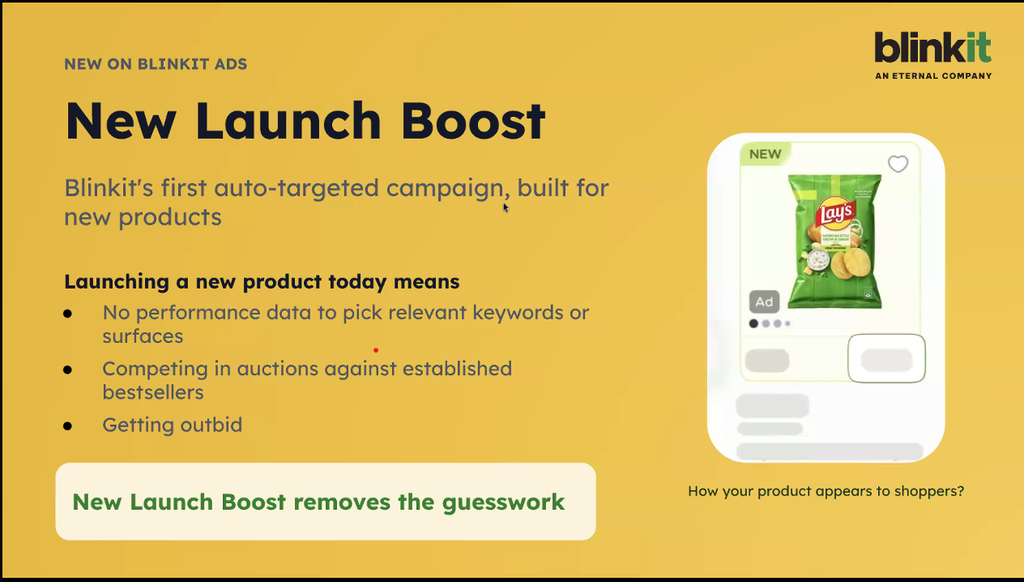
According to Blinkit’s launch material, the campaign is designed to solve three common challenges faced by new products:
- Limited performance data for identifying relevant keywords and surfaces
- Competing for visibility against established products
- Being outbid for advertising placements
New Launch Boost addresses these challenges through automated targeting, reserved placements and continuous optimisation.
Rather than manually deciding exactly where the product should appear, advertisers select the eligible products, target cities and campaign tier. Blinkit’s system then manages targeting and optimisation.
Who Is Eligible for New Launch Boost?
The format is specifically designed for new products.
Products can be eligible for New Launch Boost if they fall within the defined 90-day new-product window.
This makes the campaign different from standard performance advertising.
Instead of being designed for products with established advertising and sales histories, New Launch Boost focuses on building visibility and collecting initial performance signals for recently introduced products.
Blinkit’s campaign setup also allows advertisers to select up to seven products from the same brand and category.
How Does Blinkit New Launch Boost Work?
The setup process has three main steps.
Step 1: Select the new products
Advertisers first choose eligible products to include in the campaign. Product selection is important because additional products cannot be added once the campaign has gone live.
Step 2: Choose cities and campaign tier
Advertisers select the cities in which they want the campaign to run and the relevant campaign tier.
Blinkit provides an estimated impression range before the advertiser commits to the campaign.
Step 3: Go live
Once launched, Blinkit handles the campaign’s:
- Keywords
- Placements
- Delivery
- Optimisation
This significantly reduces the amount of manual targeting required during the initial launch period.
The First 5 Days Are the Learning Phase
An important part of New Launch Boost is its initial learning period.
The first five days are primarily used by the campaign to learn and explore.
During this period, the system can test different keywords and category surfaces to understand where the product is generating stronger results.
As the campaign collects more information, delivery can shift towards areas demonstrating better performance.
This means early campaign performance should be viewed in the context of the learning period rather than treated as the final indication of how the campaign will perform.
Automatic Keyword and Placement Optimisation
One of the major differences between New Launch Boost and traditional manual advertising is auto-targeting.
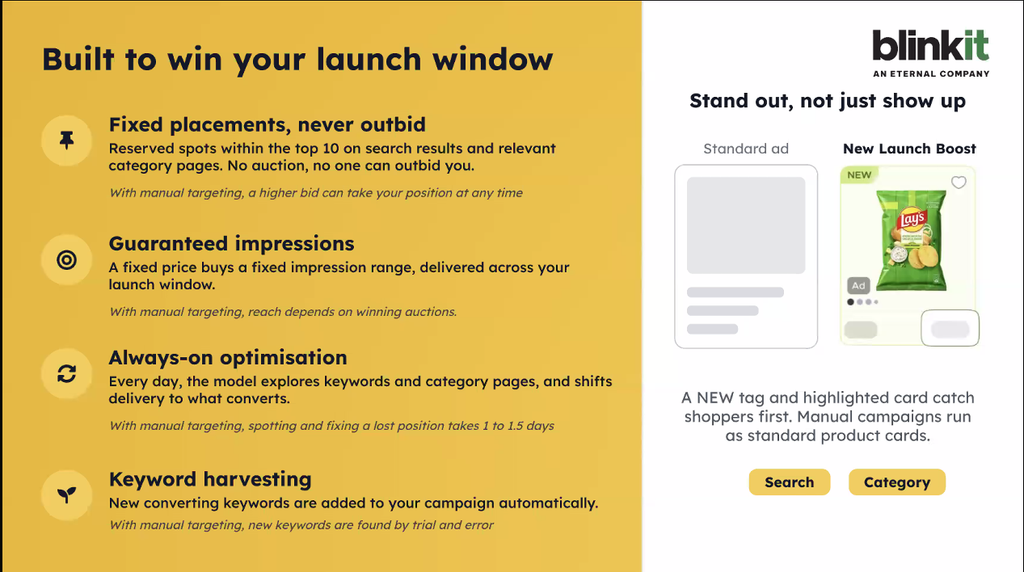
Instead of requiring advertisers to build a complete keyword strategy before launching, Blinkit’s system explores relevant keywords and category pages automatically.
The campaign then adjusts delivery based on the performance signals it receives.
Blinkit also describes a keyword harvesting mechanism through which new converting keywords can automatically become part of the campaign.
This is particularly relevant for a new product because advertisers may not yet know all the ways consumers discover or search for the product.
Reserved Placements: No One Can Outbid the Campaign
New Launch Boost also changes how products compete for advertising visibility.
Blinkit’s material describes the campaign as providing reserved spots within the top 10 positions across search results and relevant category pages.
These are fixed placements rather than conventional auction-based positions.
As a result, another advertiser cannot simply increase a bid and take the reserved position.
This provides the campaign with more predictable visibility during its launch period.
New Products Don’t Compete With Older Products in the Same Way
Under a normal auction model, a new product could find itself competing with established products that already have significant advertising and sales history.
New Launch Boost creates a different advertising mechanism for recently launched products.
Rather than relying entirely on traditional bidding dynamics, qualifying new products receive dedicated placements based on the campaign structure.
This allows advertisers to build initial visibility and collect performance data during the early stages of the product’s lifecycle.
Guaranteed Impression Ranges
The campaign also introduces greater predictability around reach.
Blinkit provides an estimated impression range before payment, with the selected campaign tier determining the level of visibility available.
The campaign then delivers against the defined impression range throughout the launch window.
This differs from manual targeting, where actual reach can depend heavily on auction outcomes and the advertiser’s ability to continuously win placements.
Search and Category Visibility
New Launch Boost is not restricted to a single advertising surface.
The campaign can provide visibility across:
Search – Products can appear when consumers search for relevant terms on Blinkit.
Category Pages – Products can also receive exposure within relevant category browsing experiences.
The New Launch Boost product card is visually differentiated through a “NEW” tag, helping communicate that the item has recently been introduced.
Daily Reporting and Search-Term Insights
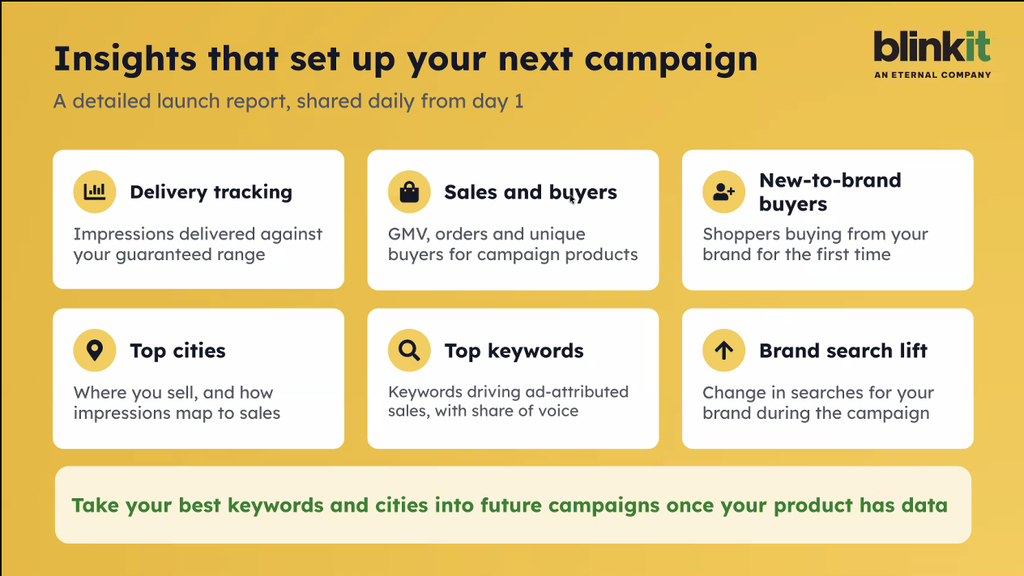
The campaign also provides reporting from Day 1.
Advertisers receive daily visibility into campaign performance, including search-term-level insights (STs).
This allows brands to understand not only whether the campaign is delivering impressions and sales, but also what is driving that performance.
The reporting covers several areas.
Delivery Tracking
Advertisers can monitor impressions delivered against the campaign’s planned or guaranteed range.
Sales and Buyers
Reporting includes:
- GMV
- Orders
- Unique buyers
New-to-Brand Buyers
Advertisers can understand how many consumers purchasing through the campaign are buying from the brand for the first time.
Top Cities
The campaign identifies cities generating stronger performance, helping advertisers understand the relationship between impressions and sales geographically.
Top Keywords
Brands can identify keywords driving ad-attributed sales and analyse keyword-level performance.
Brand Search Lift
Reporting can also show changes in searches for the brand during the campaign period.
Downloadable Dashboard Reports
Campaign data is not limited to viewing within the interface.
Advertisers can download reports directly from the dashboard for further analysis.
This can help brands use campaign data beyond New Launch Boost itself.
For example, converting search terms identified by the campaign could potentially inform the keyword strategy of subsequent performance campaigns.
Similarly, city-level insights could help determine where future media investment should be concentrated.
End-of-Campaign Report Card
Once the New Launch Boost campaign concludes, advertisers receive a campaign report card.
This provides a final view of the campaign and the learnings generated during the launch period.
The campaign therefore has two reporting layers:
During the campaign: Daily reporting and ongoing search-term insights
After the campaign: A consolidated campaign report card
For a newly launched product with limited historical data, these insights can create a useful starting point for subsequent advertising decisions.
What Controls Are Currently Limited?
Although New Launch Boost automates a significant part of campaign management, advertisers should understand the current limitations before launching.
No Negative Targeting
There is currently no negative targeting or negation functionality available within the campaign.
Advertisers therefore don’t have the same level of manual keyword exclusion that may be available in more actively managed campaign structures.
Products Cannot Be Added After Launch
Once a campaign goes live, new products cannot be added to the existing campaign.
The advertiser should therefore finalise the required product selection before launching the campaign.
Blinkit New Launch Boost vs Manual Targeting
The fundamental difference between the two approaches is the level of automation and control.
| Feature | New Launch Boost | Manual Targeting |
|---|---|---|
| Targeting | Automated | Advertiser managed |
| Keyword discovery | Automatic | Manual/testing based |
| Placement | Reserved | Auction dependent |
| Can competitors outbid? | No for reserved placement | Yes |
| Optimisation | Automated | Requires advertiser intervention |
| Impression delivery | Defined range | Depends on auction performance |
| Search-term discovery | Automated | Requires testing |
| Negative targeting | Currently unavailable | Greater manual control depending on campaign type |
| Best suited for | Newly launched products | Products with stronger existing learnings |
They therefore solve different problems.
New Launch Boost is focused on launch discovery and initial visibility, while manual campaigns give advertisers greater direct control over campaign strategy and optimisation.
What Happens After the Campaign?
One of the more useful elements of the format is that the data generated during New Launch Boost does not necessarily end with the campaign.
Blinkit specifically positions the campaign insights as something advertisers can use for future campaigns.
For example:
New product launches
↓
New Launch Boost generates initial traffic and data
↓
Campaign identifies keywords, cities and consumer behaviour
↓
Advertiser analyses the campaign report
↓
Strong keywords and cities can inform future campaigns
The campaign is therefore not only an advertising mechanism but also a way of collecting initial performance signals for products that previously had very little data.
Key Things to Know Before Launching
For advertisers considering New Launch Boost, these are the main points to remember:
- The product needs to meet the new-product eligibility criteria
- The relevant window is 90 days
- Up to 7 eligible products from a brand and category can be selected
- Blinkit automatically manages keywords and placements
- The first 5 days are used heavily for learning
- Placements are reserved and cannot simply be outbid
- Reporting is provided daily
- Search-term insights are available
- Dashboard reports can be downloaded
- A report card is provided at the end
- Negative targeting is currently unavailable
- New products cannot be added after the campaign goes live
My Take on Blinkit New Launch Boost
From a product perspective, New Launch Boost solves a genuine problem with advertising a newly launched SKU.
A new product doesn’t have the luxury of historical keyword, conversion and placement data. Giving the system time to learn while providing guaranteed visibility can help brands understand where their product is finding traction.
I also find the reporting aspect particularly valuable.
The keywords, cities, new-to-brand buyers and search behaviour identified during the campaign could provide brands with useful inputs for future campaign planning.
My concern is mainly around the cost.
New Launch Boost is a premium advertising asset, and that may make the format easier to justify for larger brands with substantial launch budgets than for smaller or emerging brands.
For a large brand launching a strategically important SKU, paying a premium for guaranteed visibility and accelerated learning may make sense.
For a smaller brand, the economics could be more challenging.
And because these are new products, advertisers should also avoid evaluating the campaign purely on immediate ROAS.
For me, the right way to judge New Launch Boost would be to look at:
Campaign sales + new customer acquisition + quality of learnings + post-campaign performance
The concept is definitely useful.
But ultimately, whether New Launch Boost is a good investment will depend on whether the incremental business and learnings generated can justify the premium price of the asset.
FAQs About Blinkit New Launch Boost
What is Blinkit New Launch Boost?
New Launch Boost is an auto-targeted Blinkit advertising campaign designed specifically for recently launched products. It automates targeting, placements and optimisation while helping brands collect initial performance data.
How old can a product be to qualify?
The campaign uses a 90-day new-product window, subject to Blinkit’s eligibility checks.
Does the advertiser need to select keywords?
The campaign is auto-targeted. Blinkit’s system explores keywords and relevant category placements and optimises delivery automatically.
How long does New Launch Boost take to learn?
The first five days are primarily used as the initial learning and discovery period.
Can another advertiser outbid New Launch Boost?
The campaign uses reserved placements, meaning another advertiser cannot simply increase a bid to take that reserved position.
Does New Launch Boost provide search-term data?
Yes. The campaign provides daily performance reporting, including search-term-level insights.
Can I add another product after launching the campaign?
No. New products currently cannot be added after the campaign has gone live.
Does New Launch Boost support negative targeting?
Negative targeting or negations are currently not available in the campaign.
Follow me on Linkedin for more content like this or read more blogs.